
To meet the needs of AI general education in undergraduate and vocational colleges, Wang Dong, Deputy Director of the Center for Artificial Intelligence General Education, Department of Computer Science and Technology, Tsinghua University, designed 50 lectures for Lectures on AI General Education based on the book Illustrated Artificial Intelligence. The lectures are now upgraded to Version 2.0. Teachers who use these lectures in classroom teaching are strongly encouraged to upgrade.
The first edition of Lectures on AI General Education was released on May 8, 2024. The PDF version was made fully available to the public, while the PPT version was made freely available to educators. Since its release, the lectures have received enthusiastic responses. As of July 30, a total of 662 teachers and educators had applied for the PPT version. They came from 585 different institutions, including 187 universities, 143 colleges and vocational colleges, and 197 primary and secondary schools. In addition to schools in China, applications were also received from educational and research institutions in Japan, the United States, Singapore, and other countries. Organizations such as State Grid Corporation of China, China Telecom, China National Petroleum Corporation, and the China National Intellectual Property Administration also applied for the lectures for internal training. The top three reasons for application were “teaching,” “reference,” and “learning.”
Teaching Scenarios
General education courses for undergraduate and vocational college students in non-computer science or non-AI majors
Introductory courses for undergraduate and vocational college students in computer science or AI-related majors
Professional training courses in AI for primary and secondary school teachers of computer science, information technology, and AI
Features of the Lectures
Based on Illustrated Artificial Intelligence, the lectures consist of 50 sessions, one session per class, with approximately 1,500 pages of slides. They cover four parts: an overview of AI, AI fundamentals, AI applications, and AI frontiers. Teachers may select materials according to their teaching needs.
The lectures do not contain mathematical formulas. The language is concise and accessible, with a large number of images and videos, making them suitable for AI general education for learners from all disciplinary backgrounds.
The lectures include teaching suggestions and key-point explanations to help teachers strengthen teaching priorities and organize their teaching ideas.
The lectures include discussion prompts and after-class assignments, most of which are open-ended questions designed to encourage student discussion and support interactive teaching.
Teachers may refer to the online resources of Illustrated Artificial Intelligence and add or adjust teaching content as needed, such as background knowledge and online demonstrations, to develop high-quality courses with their own teaching characteristics.
Teachers may join the AI Radiance community to provide timely feedback on teaching practices and receive support for issues encountered in teaching.
Updates in Version 2.0 of the Lectures
Quality assurance: Version 1.0 of the lectures has been carefully reviewed. Textual errors and layout issues have been corrected, and the wording and teaching logic have been reorganized. Version 2.0 is a quality-assured version that can be used directly in classroom teaching.
Completeness: Notes have been improved for all chapters of Version 1.0. Detailed teaching suggestions, supplementary materials, prompts for “Think About It,” and hints for after-class assignments have been added, enabling teachers to design a complete teaching process.
Frontier updates: A large number of images and videos have been added, along with recent advances such as Sora and GPT-4o, improving the timeliness of the courseware.
Copyright Statement
The lectures are available to educators for teaching use. Any organization or individual may use them for internal teaching activities after applying for registration through AI Radiance.
Teachers from the same institution must apply for copyright authorization separately.
Teachers may revise the lectures to meet the needs of teaching practice, but the logos of Tsinghua University and AI Radiance must be retained.
AI Radiance owns the copyright to the knowledge structure and knowledge content of the lectures.
The images and videos used in the lectures belong to their original creators. These images and videos are used for non-profit teaching purposes, and their sources have been credited wherever possible. Original creators who have objections to such use may contact the Center.
How to Obtain the Lectures
PDF version: The PDF version is freely available to everyone and can be downloaded directly from Baidu Netdisk: https://pan.baidu.com/s/1_rbRv4KYQJZJIf8rhNekJg?pwd=hexr
PPT source files: Teachers and educators may apply for access. Please add AI Radiance XiaoQing No. 1 on WeChat and complete registration to obtain the download link.
About Illustrated Artificial Intelligence
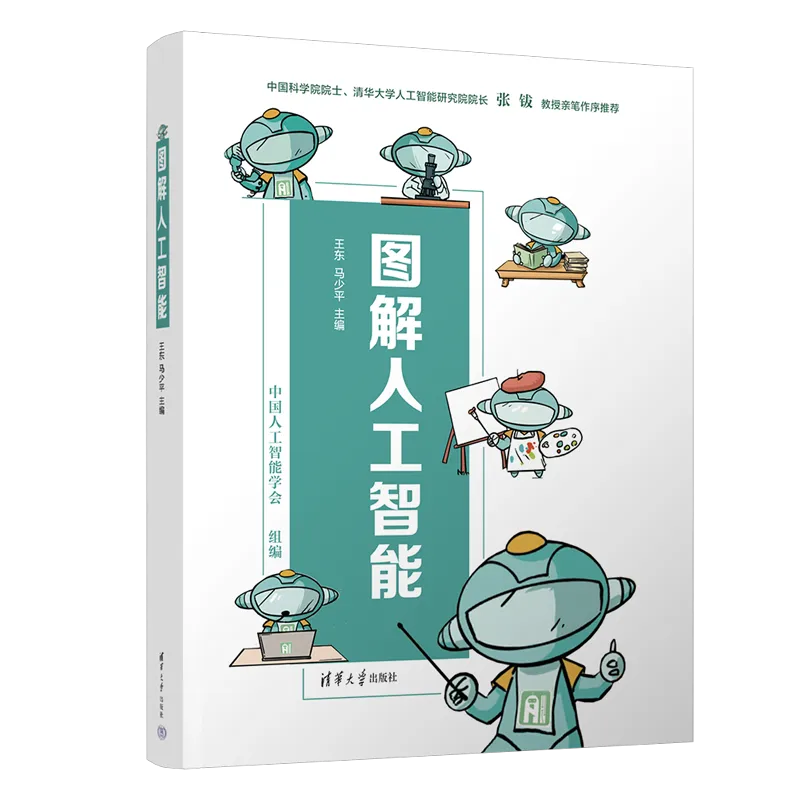
Illustrated Artificial Intelligence was edited by Wang Dong and Ma Shaoping of Tsinghua University, organized by the Chinese Association for Artificial Intelligence, and published by Tsinghua University Press. The book has been selected for the 22nd issue of Xinhua Recommended Books and was widely reposted by major media outlets such as Xinhuanet and Banyuetán. It was also included in the 2023 Good Books Awards by Brand Publishers on CCTV-10’s Reading program, selected as a recommended popular science book by the China Computer Federation in its fourth CCF Popular Science Reading list, and recognized as a 2023 Excellent Popular Science Work in Information and Communications.The book provides an in-depth introduction to artificial intelligence from multiple perspectives, including basic concepts, historical development, fundamental algorithms, representative applications, the latest research progress, and interdisciplinary achievements. With a complete system, strong scientific grounding, and authoritative content, the book presents knowledge through illustrations in an accessible and easy-to-understand way, making it well suited for AI general education.